The New Year has a peculiar effect on the human psyche. It slows the world down just enough to allow a dangerous thing to occur: thinking. We look back at the previous twelve months and assess what worked, what drained our patience, and what quietly ceased to make much sense.
.
For many, this moment of clarity arrives immediately after opening a familiar social media app and facing the same profound emptiness.
Another year of doom-scrolling. Another year of shouting into the void. Another year of being omnipresent digitally, yet connected to absolutely no one. If you are craving a fresh start, you are not alone. Perhaps that fresh start isn’t about consuming better content, but about finding a better room in which to consume it. It is time to stop renting space in a chaotic public square and start building connections in a place that actually has walls, a roof, and—miraculously—civilised conversation.
.
The Uncomfortable Truth: You Are Not the Customer
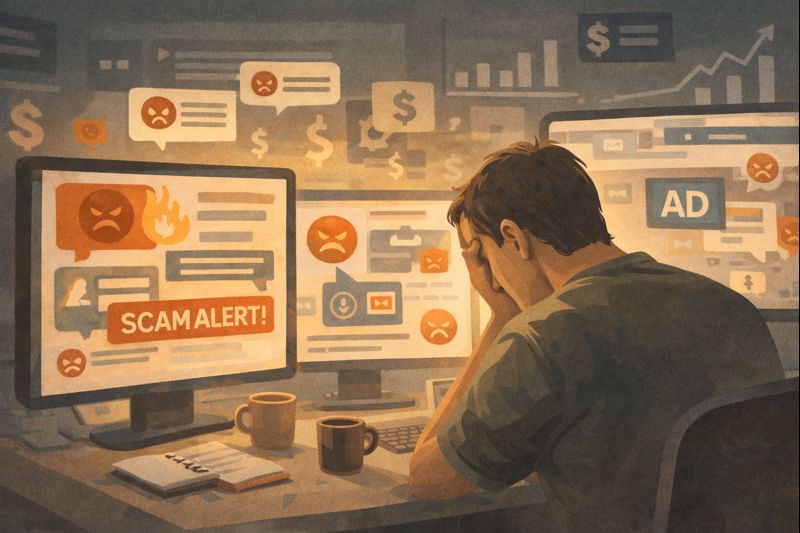
Let us be candid about the large social networks. They are not designed for your personal growth, your mental well-being, or your desire to see photos of your aunt’s new conservatory. They are built for engagement graphs and advertising revenue.
This reality becomes painfully obvious when things go awry. Harassment spreads on these platforms because conflict keeps people glued to their screens—rage is a terribly efficient fuel for engagement. Scams flourish because speed is prioritised over safety. Support systems feel distant because, frankly, genuine care does not scale to billions of users.
On the giants of social media, you are not valued as a person. You are valued as ‘activity’. You are a data point with a pulse.
As we stare down the barrel of a new year, it is a prudent moment for honesty. Do you really wish to spend another twelve months donating your time and energy to platforms that view you as a renewable resource rather than a human being?
.
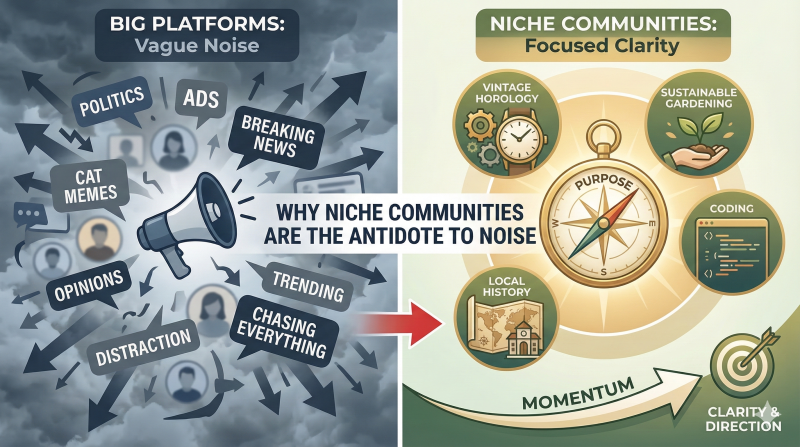
Why Niche Communities Are the Antidote to Noise
New Year’s resolutions often fail because they are dreadfully vague. “Be healthier.” “Be more productive.” The large platforms thrive on this vagueness because it keeps everyone chasing everything simultaneously.
Smaller, niche communities—forums, dedicated discussion groups, private servers—are the antithesis of this. They are focused. They are intentional. They know exactly what they are, and perhaps more importantly, what they are not.
Whether the niche is vintage horology, sustainable gardening, coding, or local history, these focused communities offer direction. When you join a forum dedicated to a specific passion, you are not bombarded with political arguments or cat memes (unless, of course, it is a forum for political cats). You are there for a purpose. That clarity creates momentum, which is precisely what we are all searching for in January.
.
Leaving Bad Habits at the Door
A fresh year is an opportunity to unlearn the bad habits we have picked up from the algorithm. The endless scrolling, the dopamine chase for ‘likes’, the measuring of self-worth against the highlight reels of strangers. These behaviours do not vanish by magic; they vanish when you change your environment.
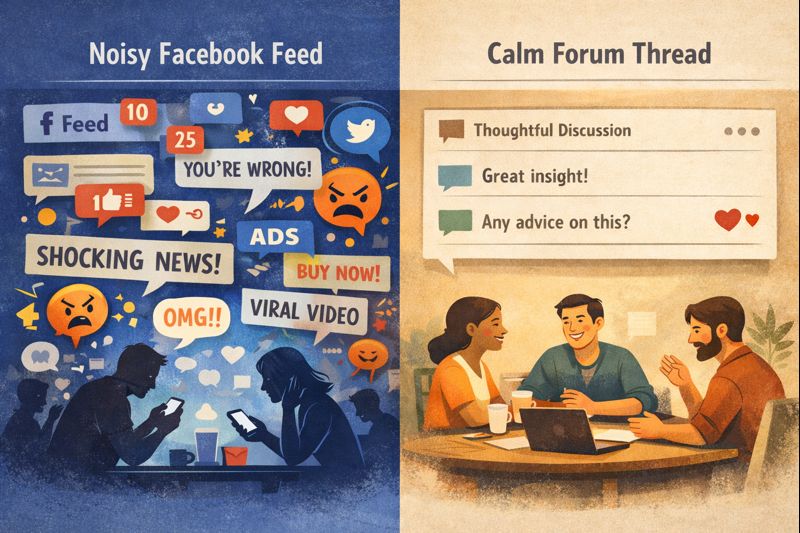
In a smaller community, the pace is mercifully slower. People actually read what you write. Conversations span days, not seconds. You are not screaming to be heard over millions of strangers; you are speaking to a room of peers. That shift alone feels like a reset for the mind. It is the difference between a shouting match in a crowded stadium and a dinner party with friends.
.
Accountability: The Death of the Troll
One reason social media feels so toxic is the lack of accountability. When you are one of millions, you are invisible. Nobody notices when you leave; nobody cares if you are rude.
In niche forums, however, people recognise you. They remember your username. They recall that you helped them solve a problem last month. They notice your growth, and they notice your absence. This gentle accountability fundamentally alters behaviour.
Bullying loses its power in these spaces. Trolls and scammers tend to avoid places where trust must be earned rather than exploited. Toxicity fades when people are no longer anonymous and disposable. This isn’t merely good moderation; it is good community design. It is difficult to be rude to someone when you know you will have to see them again tomorrow.
.
Moving from ‘User’ to ‘Member’
Joining a smaller community marks a radical shift in your relationship with the internet. You stop performing for an algorithm and start interacting with people.
In these spaces, you decide what kind of energy you engage with. You contribute to a culture rather than just consuming a feed. There is a sense of ownership that comes with being a “regular” on a good forum. You aren’t just a user; you are a member. You serve and support others, and they return the favour.
In a digital world brimming with artificiality and bot-generated comments, daring to join a space where you must be a real person is a revolutionary act. Real connections are rare. They are worth the effort.

.
Quality Over Quantity
A common trap is assuming that “bigger” means “better”. It does not. A discussion board with 300 engaged members who genuinely care about the topic will provide more value than a Facebook group of 50,000 people shouting past one another.
Ask yourself: Is it better to have 10,000 “friends” who don’t know your surname, or three real connections who understand your perspective? It is about quality, not quantity. Depth is what sustains motivation long after the January enthusiasm has faded.
-
When you feel seen and valued, you stay.
-
You interact. You contribute. You learn.
-
You invite others to join the conversation.
This year, do yourself a favour: log off the noise, and log in, to a community.
Please feel to share this with your social contacts...